Rackspace's price hikes are a signal it’s time to move clouds. Here's where to go.

In January 2026, Rackspace customers opened their invoices to find their email hosting had increased by 400%, from $2.99 to $10 per mailbox per month, with six weeks' notice. One reseller reported their monthly bill jumping from $2,400 to $5,100 overnight effectively eating their margin.
A hosting company that had been a Rackspace customer for 27 years saw a 706% increase in email.
"We are writing to inform you that effective February 10, pricing for our Rackspace OpenStack Public Cloud platform will increase by 100%. This adjustment reflects the ongoing requirements of operating legacy infrastructure and aligns with our broader platform strategy." - Reddit post
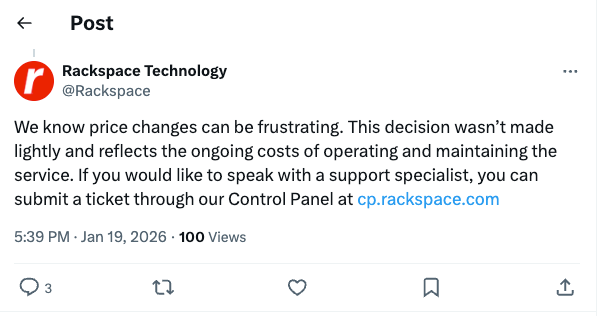
Rackspace's response on X: "We know price changes can be frustrating."
A company confident in its product competes on value. A company under financial pressure extracts value from its existing customer base.
What's behind the Rackspace price increases
Rackspace is managing a business under significant stress. After filing for Chapter 11 bankruptcy in 2023 and completing a debt restructuring, the company holds a B- credit rating from S&P Global as of 2024, distressed-credit territory.
Revenue from its legacy private cloud segment declined 14% in the fourth quarter of 2023 as customers rolled off discontinued OpenStack products.
The price increases are a symptom of that pressure.
When your cost base is fixed, and your revenue is shrinking, you raise prices on the customers who haven't left yet. The customers most likely to absorb the increase are the ones with embedded dependencies where switching feels harder than it is.
Why Akamai Connected Cloud is the right destination to move from Rackspace
Akamai Connected Cloud (formerly Linode) is the clearest alternative for Rackspace customers migrating IaaS workloads. The economics are different at a structural level, not because of promotional pricing, but because of how the platform is built.
Predictable, flat pricing. CPU, RAM, storage, and transfer are bundled into a single monthly rate. There are no mid-contract price adjustments, no per-request charges, no support tier upsells. The price you see is what you pay.
Network-native egress. Akamai's cloud runs on the same infrastructure as the world's largest CDN. Egress costs are significantly lower than Rackspace, AWS, or Azure for equivalent transfer volumes. For customers running data-heavy workloads, that single line item can represent 30–40% of the total infrastructure bill.
No vendor lock-in. Akamai uses standard open-source tooling throughout. This means Kubernetes via LKE, S3-compatible Object Storage, standard VM images. There are no proprietary abstractions that make leaving difficult. Portability is a design principle, not a marketing claim.
LKE for containerised workloads. Linode Kubernetes Engine is standards-compliant managed Kubernetes with a 99.9% SLA and dedicated 10 Gbps ingress on the Enterprise tier. For teams containerizing as part of the migration, it removes the operational overhead of self-managing a cluster.
Maxima's track record. Maxima is Akamai's Cloud Compute Services Partner of the Year. We can confidently deliver Rackspace-to-Akamai migrations in a matter of weeks. The average outcome in a migration to Akamai that we’ve seen so far with our clients is 40% TCO reduction.
What the migration from Rackspace to Akamai Cloud actually involves
Migrating from Rackspace to Akamai is not technically complex. It is a planning and sequencing challenge more than a technical one. We follow a proven process for cloud-to-cloud migration projects:
Workload inventory (1–2 weeks). Before anything moves, you need a clear map:
- what is running,
- what it depends on,
- what the performance and compliance requirements are.
This produces a migration priority list, most workloads can migrate as-is to Akamai Compute instances in the first pass. But we prefer to optimize them for the target environment to reap full benefits of the new platform.
Environment provisioning (1–2 weeks). The Akamai environment (networking, storage, load balancing, Kubernetes if applicable) is built and validated before a single production workload moves. You are migrating into a working environment, not building as you go.
Workload migration (2–4 weeks). Migration proceeds in priority order: lowest-criticality workloads first, production last. For servers, image-based migration handles most cases. For databases, we use replication-based migration: establish an Akamai-hosted replica, wait for lag to reach zero, then promote and flip the connection string.
Operational handoff. Teams that relied on Rackspace's managed services layer need a replacement model. Maxima provides SRE as a Service for Akamai environments (24/7 monitoring, incident response, cost optimization, and platform engineering) typically at 20–30% lower cost than the Rackspace managed layer it replaces.
For a medium-complexity environment (20–50 servers, 3–5 applications), the total elapsed migration time is four to six weeks. The migration investment is typically recovered within 8–12 months through ongoing savings.
The window to act for a migration off Rackspace
Rackspace's 2026 price increase was not its first. It will not be its last. Each price increase is an attempt to stabilise margins at the expense of customer trust.
The customers who are still on Rackspace in 12 months will be the ones who either couldn't find a path out, or assumed the disruption wasn't worth it.
I know that a controlled migration, that is planned, sequenced, with parallel environments running until the new platform is validated, is far less disruptive than most teams expect.
A workload assessment takes one week and tells you exactly what you have, what Akamai costs for the equivalent, and how long the payback period is. That is the starting point.
If you’re interested in such a move, send me a message and I’ll connect you with our solution architect.
Or get in touch directly at https://www.maximaconsulting.com/contact-us