Follow-the-sun database operations: how 24/7/365 actually works
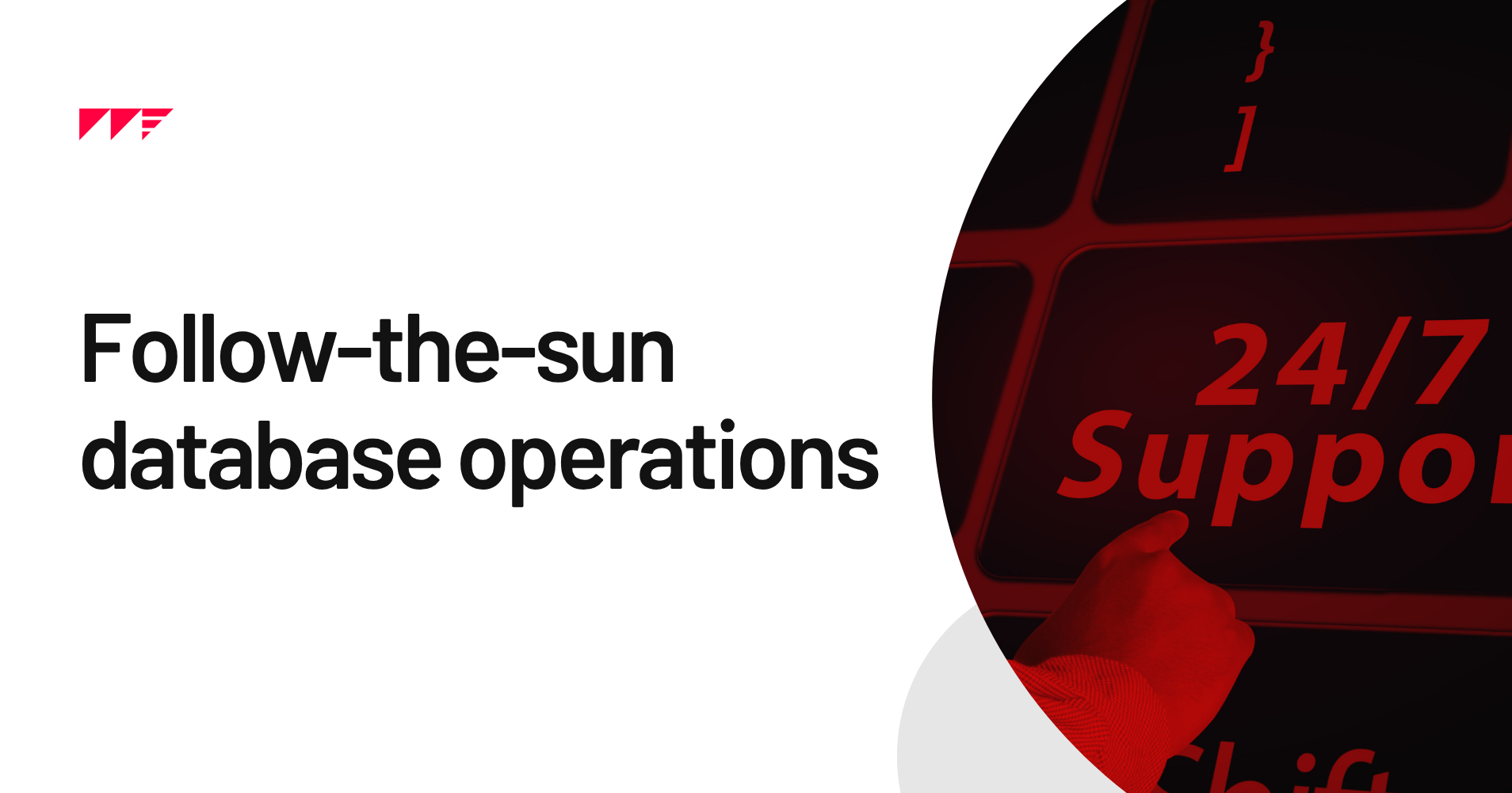

Every provider in this industry says "24/7 support." I've never seen a sales deck without it.
So here's a fun exercise: next time you hear it, ask what those numbers physically mean. Who, exactly, is doing what at 3:40 AM your time on a Sunday?
You'll get one of three very different answers, usually sold under the same label.
The three things "24/7" can mean
An answering service.
Someone acknowledges your ticket at any hour. The engineer sees it in the morning. Technically, you were supported 24/7. Practically, your database waited six hours for a sunrise.
An on-call rotation.
A real engineer gets paged and woken up. Better. But you're now being helped by someone who was asleep four minutes ago, working from a laptop on a kitchen table, alone, possibly seeing your environment for the first time this month. Some of the best saves in this industry have happened exactly like that. So have some of the worst mistakes.
A follow-the-sun operation.
Nobody gets woken up, because somewhere on the planet, a full team is simply... at work. Wide awake, mid-shift, coffee already finished. The incident doesn't wait for a person; it travels to the people.
These three cost very different amounts to build, which is why the label gets stretched to cover all of them.
How the handoff actually works
Follow-the-sun stands or falls on one thing: the handoff. Moving an incident between continents without losing the plot is a discipline.
Here's the shape of it, using our own setup: engineering teams in Kraków and Pune, covering the clock between them along with our other hubs, every day of the year.
When a shift ends, open work doesn't get parked; it gets briefed. The receiving team gets the live context: what's happening, what's been tried, what's ruled out, what the current hypothesis is, and what the client has been told. Runbooks, monitoring history, and past incident records live in shared systems, so the context is in the tooling, not in one tired person's head.
Done right, the client experience is a little surreal: you go to sleep mid-incident talking to one engineer and wake up to a resolution note from another, and the thread never broke.
Done wrong, follow-the-sun is just three answering services in a trench coat. The handoff is where you can tell the difference.
Why this matters more for databases than almost anything else
Databases are where time-to-response converts directly into risk. While a web server waits for attention, users see errors. Annoying, recoverable. While a database waits, replication lag grows, backup windows slip, disks fill, and a contained incident matures into data loss exposure.
Every silent hour compounds, and the meter is running the whole time: the ITIC 2024 study puts hourly downtime above $300,000 for over 90% of mid-size and large enterprises. Six hours of waiting for a sunrise is not a scheduling inconvenience; it is a seven-figure exposure on a bad day.
That's why the model behind "24/7" is a materially different product depending on which of the three you're buying, even if the slide looks identical.
Where we stand
Maxima Consulting runs managed databases 24/7/365 on a genuine follow-the-sun model from Kraków and Pune, under a 99.99% uptime SLA enforced end to end, with deployments in the client's own cloud accounts.
It's the operating backbone behind our longest engagement: over ten years of business-critical database operations for a global financial institution, zero major outages, and perfect around-the-clock availability (case study). The same coverage model runs across our whole managed SRE practice.
Follow-the-sun is the expensive way to build coverage, and for a small, non-critical estate, a good on-call rotation is a perfectly reasonable buy. The model earns its cost where the database can't afford to wait for a sunrise. You know which kind of estate you have.
FAQ
What is follow-the-sun support?
An operating model where full teams in different time zones hand off work to each other as their business days end, so incidents are always handled by engineers who are awake and on shift, rather than paged from sleep or queued for morning.
What is the difference between follow-the-sun and on-call?
On-call wakes an engineer to handle an incident alone, outside working hours. Follow-the-sun moves the incident to a team already mid-shift. The difference shows in response quality, decision authority, and how multi-hour incidents hold together.
Why does follow-the-sun matter for databases specifically?
Database incidents compound with time: replication lag, slipping backup windows, and disk pressure all grow while a ticket waits. Coverage gaps that are tolerable for stateless services translate into data loss exposure on the data layer.
How can I verify a provider's 24/7 claim?
Ask for the story of a real overnight incident (who touched it, in which time zones), what the overnight team may decide alone, and a real, anonymized handoff record. All three artifacts exist in a genuine operation and are awkward to fake.